Hungary’s leading figures in culture and science were honored on Saturday at the Parliament, where President Tamás Sulyok presented the prestigious Kossuth and Széchenyi Prizes, highlighting the role of science and the arts in bringing Hungarian communities together.
“The people of Hungarian science and culture, through their work and creations, unite us, strengthen us, build, and enrich all of us,” President Sulyok said. “Science and the arts can be seen as bridges, and the people of Hungarian science and culture as bridge-builders.”
The Kossuth Grand Prize, Hungary’s highest cultural honor, went to composer and pianist György Kurtág and sculptor Miklós Melocco.
The Kossuth Prize is Hungary’s most prestigious award in the fields of art and culture. The first prizes were awarded on March 14, 1948, on the centenary of the 1848 Revolution, to the country’s outstanding scientists, artists, and creators.

File photo of György Kurtág, Wolf Prize-winning composer and pianist, two-time Kossuth Prize winner, and three-time Erkel Ferenc Prize recipient. Photo: Hungary Today

Miklós Melocco, Kossuth Prize- and Mihály Munkácsy Prize-winning sculptor, and holder of the Hungarian Corvin Chain. Photo: MTI/Illyés Tibor
Other Kossuth Prize winners included filmmaker Gábor János Csupó, singer and actress Mónika Fischl, actor and director Tibor Gáspár, composer Levente Gyöngyösi, singer-songwriter Magdolna Rúzsa, and poet János Lackfi. Shared awards went to folk musicians such as István “Szalonna” Pál and Eszter Pál.
The Széchenyi Prize, recognizing outstanding achievements in science and engineering, was presented to 15 individuals this year,
including Nobel and Wolf Prize-winning physicist Ferenc Krausz, archaeologist Tivadar Vida, mathematicians Péter Komjáth and Imre Lengyel, and biologist Csaba Pál.
Fact
The Széchenyi Prize was established by a decision of the Hungarian Parliament on January 25, 1990, replacing the former State Prize. Since then, it has been awarded every year on March 15 to outstanding figures in science and engineering. The prize was first awarded in 1990: in addition to seven individual recipients, two collectives received the award, and 12 posthumous recognitions were also granted.The prize has two levels — the Grand Prize and the Prize — and the Grand Prize has been awarded only on a few occasions so far.
President Sulyok connected the awards to Hungary’s historical legacy, recalling the spring of 1848, when the nation laid the foundations for civil law and a modern state. “From the spring of 1848 and the subsequent struggle for freedom, the whole nation has drawn strength ever since,” he said. “The courage and sacrifices of those great Hungarians underpin our homeland’s freedom and rule of law.”
He stressed that national unity should exist alongside individual differences, noting:
Being Hungarian means belonging to another Hungarian with whom we share the nation. Our history has shown that even broken, diminished, or divided, we can hold together.”
The awards were presented in the presence of Prime Minister Viktor Orbán, László Kövér, Speaker of Parliament, former presidents János Áder and Pál Schmitt, and Minister of Culture and Innovation Balázs Hankó.
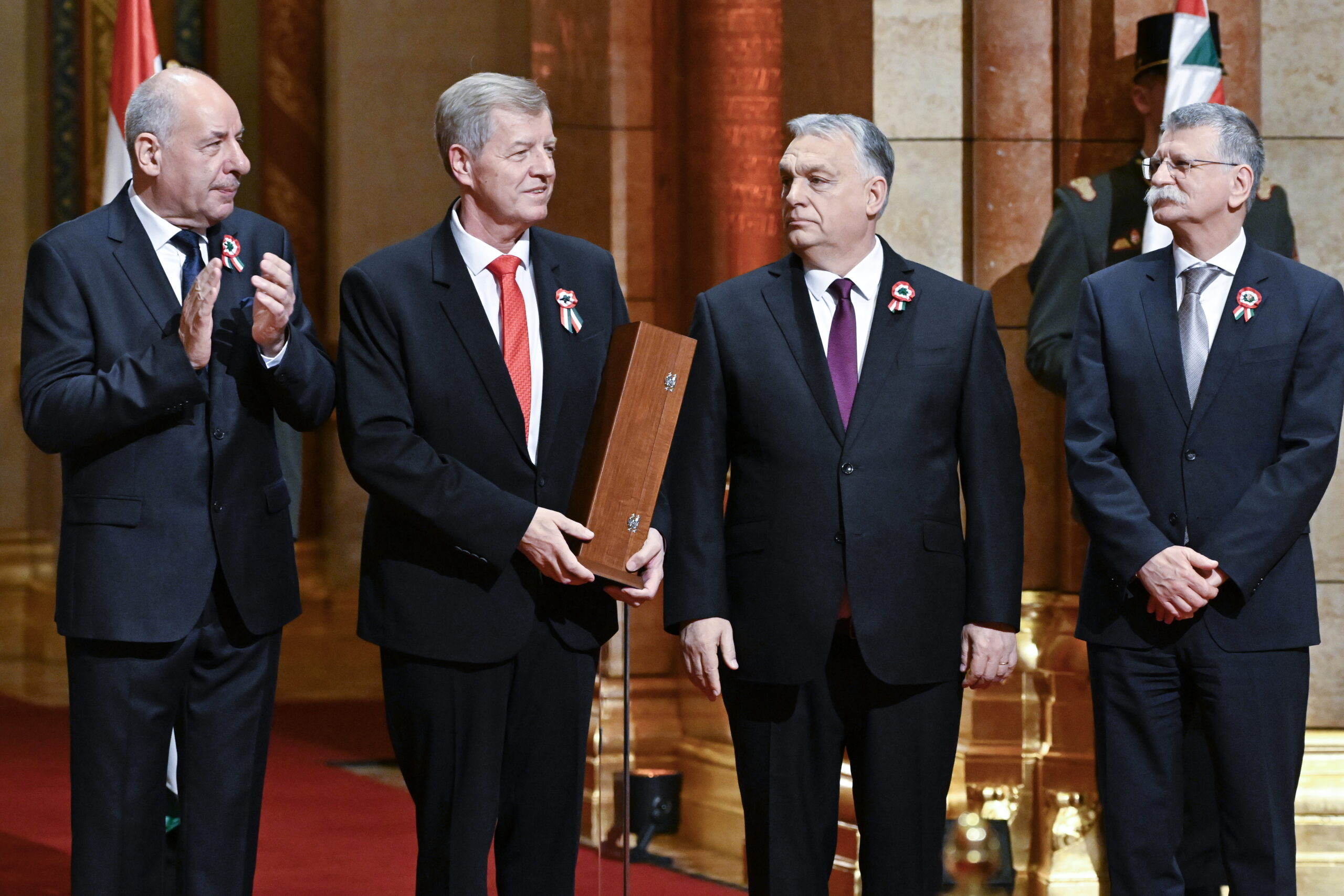
Via hirado.hu, Featured image: MTI/Máthé Zoltán
The post Prominent Cultural and Scientific Figures Receive Kossuth and Széchenyi Prizes appeared first on Hungary Today.





