Festive light projections illuminating the façade of the National Museum, Budapest, March 15, 2025
March 15 marks the birth of modern parliamentary Hungary, commemorating the start of the Civic Revolution and the War of Independence of 1848–49. The aim of the revolution was to end Habsburg rule, secure national independence, and establish a constitutional system.
On March 15, 1848, a revolution broke out in Pest-Buda, as it did in many other European cities. It was driven by the ideals of national and universal freedom and by demands for sweeping civic and political reform.
The Opposition Circle of Pest – a radical group of young intellectuals – had already entered the political arena on March 5, 1848, by joining the debates of the estate-based Diet in Pressburg. They launched a signature campaign supporting the proposal submitted by Lajos Kossuth on March 3.
Kossuth called for an equal sharing of public burdens, political equality, popular representation, and the creation of an independent Hungarian government.
Originally, the campaign was planned for March 19, followed by a reform banquet modeled on French political gatherings at Rákos Field. There the organizers intended to present their famous Twelve Points, in which the key demands of Kossuth’s proposal were distilled into revolutionary slogans by József Irinyi.
Events soon overtook those plans. On the evening of March 14, news reached Pest-Buda that revolution had broken out in Vienna the day before. The young activists gathered at the Pilvax Café decided to act immediately.

Pilvax Café, a key location of the revolutionary events of 1848. Colored pen drawing by József Preiszler. Photo: Wikimedia Commons/Public Domain
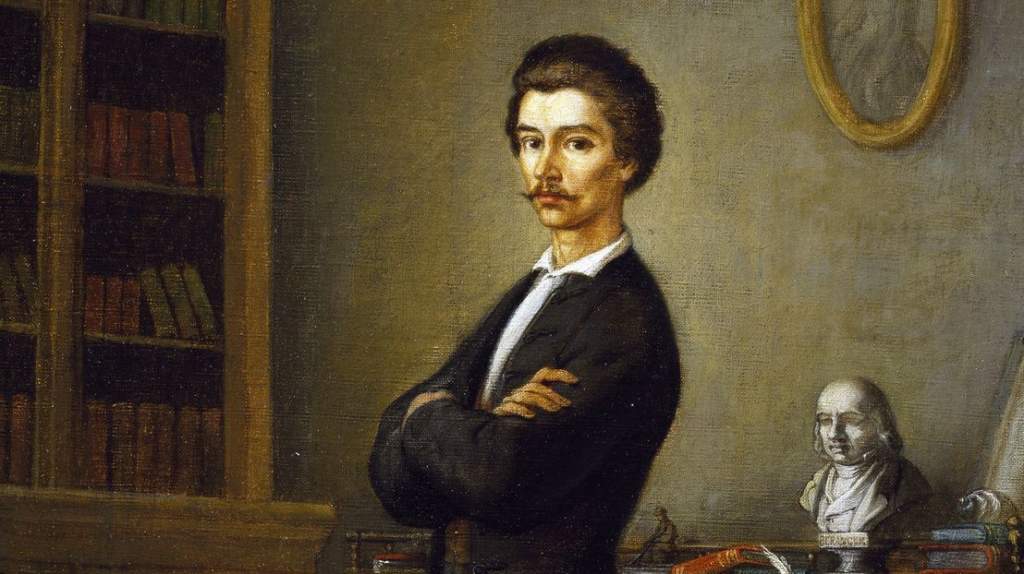
On the morning of March 15, Sándor Petőfi, Pál Vasvári, Mór Jókai, and Gyula Bulyovszky revised the introduction to the Twelve Points addressed to the Diet and drafted a declaration explaining their political actions.
The manifesto was read aloud to the young men assembled in the Pilvax Café. Petőfi then recited his poem “Nemzeti dal” (“National Song”), written two days earlier and originally intended for the reform banquet scheduled for March 19. Soon afterward, Petőfi and about ten of his companions set off from the café in a light drizzle toward the universities. They first addressed medical students, then students of the Technical University, and finally law students. At each stop the declaration and the Twelve Points were read out, while Petőfi recited his poem.

Manuscript of Sándor Petőfi’s poem “Nemzeti Dal” (“National Song”). Photo: Wikimedia Commons/Public Domain
As students and passersby joined the movement, the increasingly enthusiastic crowd grew to around two thousand people. Led by Petőfi, they marched to the nearby Landerer and Heckenast printing house at the corner of Hatvani Street (today: Kossuth Lajos Street) and Szép Street.
There, the leaders of the youth movement seized the printing presses in the name of the people and printed the “National Song” and the Twelve Points without censorship.
Shortly before noon, József Irinyi personally distributed the leaflets—the first printed products of Hungary’s free press.
The text of the Twelve Points was later slightly revised; the final demand was expanded to include “Union with Transylvania.”
Encouraged by their success, the revolutionaries organized a mass rally at 3 p.m. in front of the National Museum. By then the crowd had swelled to tens of thousands. From there they marched to the Pest city council, persuading its members to support their demands.

A Hungarian kokárda, dating from around 1848, worn as a revolutionary emblem by supporters of the Hungarian Revolution of 1848. Since then it has become a lasting patriotic symbol of Hungarian national identity. Photo: Wikimedia Commons/Public Domain
A revolutionary committee was formed, after which the crowd moved on to Buda to confront the Governor’s Council. Accompanied by a massive crowd, committee representatives—including Pál Nyári, deputy lord lieutenant of Pest County; Lipót Rottenbiller, deputy mayor of Pest; and Gábor Klauzál, envoy of Csongrád County—presented their demands.
Faced with the pressure of the crowd, the Governor’s Council accepted the Twelve Points, immediately abolished censorship, and ordered the release of Mihály Táncsics, who had been imprisoned in 1847 for press offenses and incitement. The jubilant crowd escorted him in triumph back to Pest.

A folk dance performance in Budapest on March 15, 2025, marking the 177th anniversary of the outbreak of the Hungarian Revolution of 1848. Photo: MTI/Szigetváry Zsolt
Meanwhile, in Pressburg, the lower chamber of the Diet passed a resolution declaring that Kossuth’s March 3 proposal included the abolition of serfdom—with state compensation—and the introduction of universal taxation. A delegation of the National Assembly then traveled to Vienna to present the proposal, which had also been approved by the upper estates, to the king.
March 15 remains a day closely associated with youth and the future.
At the time of the revolution, Petőfi was only 25 years old, Mór Jókai just 21, and one of the oldest among the key revolutionary figures, Pál Vasvári, had only recently turned 28.

The statue of Lajos Kossuth during commemoration of the outbreak of the Hungarian Civic Revolution and War of Independence, held in Salonta (Nagyszalonta, Romania) on March 15, 2025. Photo: MTI/Lehoczky Péter
It is no coincidence that the revolutions of March 1848 are often called the “springtime of the peoples.” The Hungarian revolution and war of independence were both influenced by—and contributed to—wider unrest across Europe, including uprisings in Italy and France and later in Vienna and Berlin.
Hungary’s revolution did not occur in isolation – it was part of a broader popular movement that shook the continent.
The message often associated with this day is that meaningful change begins with the younger generation and must extend beyond national borders.
In this spirit, the Rákóczi Association organizes cross-border trips for secondary school students on Hungary’s national holiday. Over 5,000 students from 122 secondary schools across the Carpathian Basin travel to other Hungarian school communities to celebrate and commemorate the War of Independence of 1848–49. Eighty-eight groups come from Hungary, sixteen from Transylvania, and nine each from southern Slovakia and Vojvodina (Serbia).
Via mult-kor.hu, Featured image: MTI/Bodnár Boglárka
The post March 15, 1848 – The Day Freedom Took to the Streets of Budapest appeared first on Hungary Today.





