Most of the traditions and superstitions that are still alive today are linked to Christmas, although many festive customs have by now partly or completely faded into obscurity – unfortunately, as many of them are quite amusing. The Christmas customs of the past were extremely rich and varied, with many different versions depending on the region and the era. In this article, we revive some of those forgotten traditions.
Witches and pig snorting
One of the most important purposes of St. Lucy’s Day was to ensure the fertility of hens. Women did not work on this day because they believed that otherwise the hens would not lay eggs. This was linked to the tradition of “kotyolás” (or: “lucázás”): boys aged 7–16 went from house to house, sat on straw or wood, and chanted. It was in the hosts’ interest to invite them in and give them gifts, because if they failed to do so—in addition to jeopardizing next year’s egg harvest—the boys would later take revenge on them with mischief. The host would put away the straw or wood they sat on to ensure that the hens remained fertile.
Love predictions also played an important role on St. Lucy’s Day.
Girls wrote men’s names on pieces of paper, which they burned before Christmas or hid in dumplings: the one that rose to the top of the water first indicated their future husband.
According to other beliefs, if a girl knocked on the pigsty and the pig snorted, it was certain that the maiden would find her true love the following year (in other versions, it was certain that she would not).
On St. Lucy’s Day, work had to begin on carving a Luca chair consisting of thirteen pieces. There could be no nails in the chair being made, and it had to be assembled in 13 days so that it would be ready for midnight mass on Christmas Eve. This is when it gains its magical function:
if someone in the church stands on the chair at midnight during mass, they will see the witches, whose special distinguishing feature at this time is that they wear horns.
However, after successfully spying on the witches, it was advisable for the observer to flee the scene, otherwise the witches would tear them to pieces in revenge for exposing them. While running home, it was recommended to scatter poppy seeds along the way, because the witches had to pick them up, thus allowing the observer to escape.
Traditions of going from house to house
The best-known Christmas folk game is nativity plays, in which men or children dressed up and performed the story of the birth of Jesus. The characters could be shepherds, angels, or King Herod, and they often brought homemade manger scenes with them. They greeted the residents, performed the story, and then collected donations.
This tradition was particularly strong in Transylvania, where thoroughly rehearsed performances were presented.

Children’s nativity play, 1923. Photo: Fortepan / Göcseji Múzeum / Morandini-Schlemmer hagyaték
During Christmas caroling—also known as mendikálás, kóringyálás, or pászilás—Christmas songs and good wishes were performed. At noon, children, later teenagers, and in the evening adults went from house to house and received gifts as a reward.
Another widespread custom was the so-called “whip carrying” (“vesszőhordás”). Shepherds would visit houses with whips, and the housewife would pull a few strands from the bundle and whip the farmhand with them. In other versions, she would whip the livestock to keep them healthy. In return, the shepherd would receive brandy, food, or money.
Regölés is a winter folk custom that involves groups of young men, sometimes with musical instruments, going from house to house to perform songs, chants, or ritualistic verses called regös songs.
The custom of regölés has pagan origins, probably dating back to ancient Hungarian history.
Some scholars note parallels with shamanic chants in terms of rhythm, repetition, and symbolic content.
The regösök usually went from December 26 to New Year’s Day, performing their rhymes and good wishes in the spirit of fertility. From the day after Christmas until January 6, they would go around the village, singing regös songs at every house, and of course, they did not leave empty-handed.
From today’s perspective, there was a very strange custom: on December 28, the day of the Holy Innocents, children were sent to the neighbors, where they were spanked with a switch, which, according to popular belief, kept them healthy.
The holiday and the Christmas tree
The origin of the Christmas tree is uncertain. According to several theories, it is a German tradition, while others link it to Martin Luther. Some research suggests that Martin Luther was the first to decorate a Christmas tree, and there are several legends surrounding this. One of the most charming stories tells that Martin Luther was walking home one winter evening when he was so enchanted by the sight of starlight sparkling on the pine trees that he wanted to show it to his family at home, hence he placed candles on a pine tree.

Szaloncukor hanging on a family’s Christmas tree in Budapest, 1940. Photo: Fortepan / Tivadar Lissák
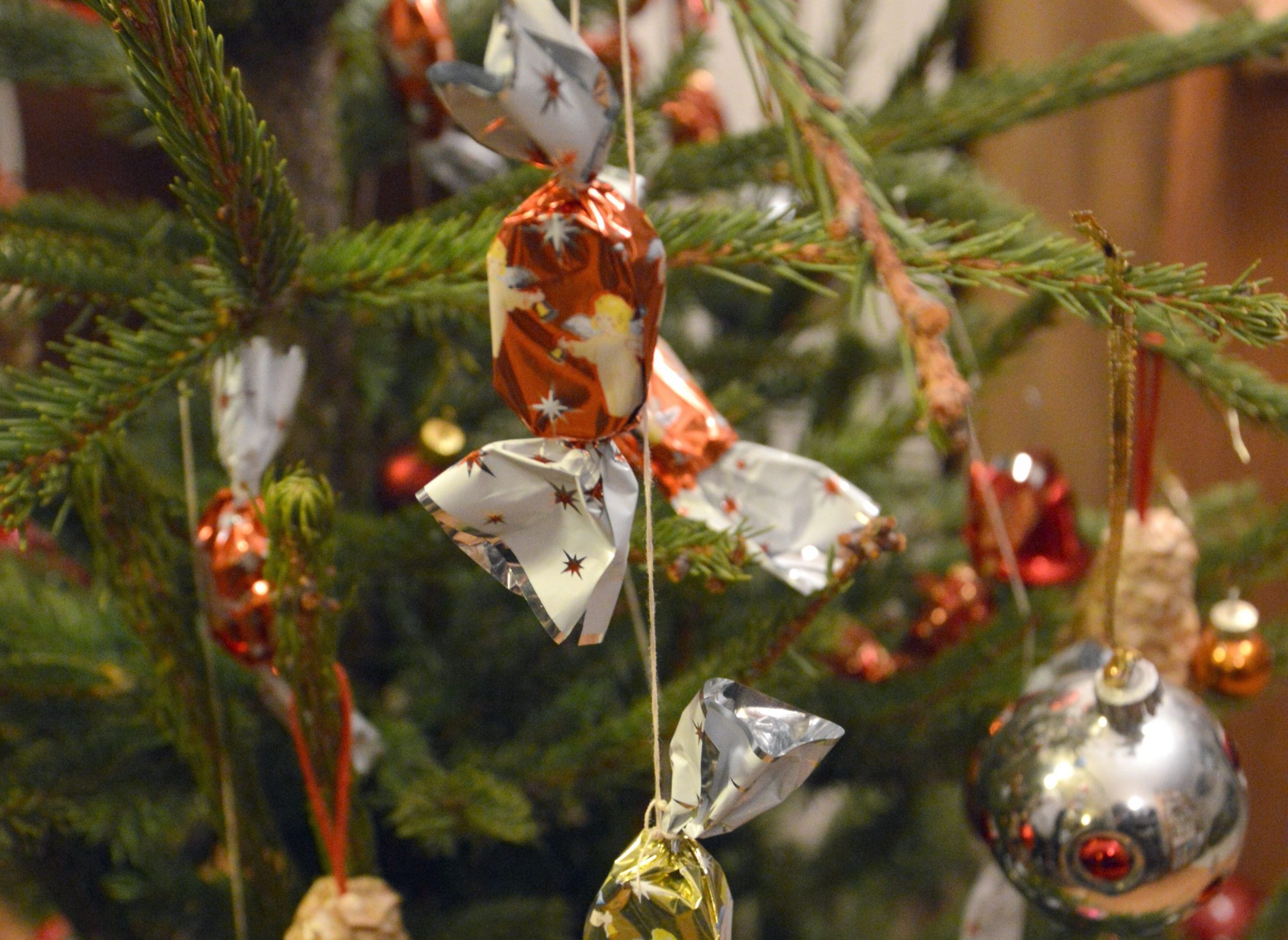
In Hungary, according to tradition, Teréz Brunszvik (founder of the first kindergartens in the country) set up the first Christmas tree in 1824. The custom only became widespread in the first half of 20th century, and in many places it became common after 1945. In the past, the tree was decorated with apples, walnuts, gingerbread, dried fruit, and candles, but the tradition of hanging “szaloncukor” (Christmas candy of fondant covered in chocolate) on trees was also widespread. Today, the iconic sweets, wrapped in shiny tin foil, are still a highlight on Hungarian families’ Christmas trees. The candy was officially added to the Hungarikum collection in 2024.
Christmas table and beliefs
There were many superstitions associated with Christmas meals. Seeds and straw were placed on the table: the seeds were later given to the poultry, and the straw was used for the health of the livestock or in the hope of a good harvest.
The housewife was not allowed to get up from the table or lean on her elbows, as this endangered the hens’ egg production.
On Christmas, beans, lentils, and poppy seeds were eaten as symbols of abundance. Apples were often eaten together to keep the family united. The crumbs were used to feed animals, for healing, or to ward off evil. In some places, food was left on the table for angels or the dead who arrived during the night. On December 27, wine blessed in church was later used for healing.

Via turistamagazin.hu, Featured image: Fortepan / Lissák Tivadar
The post Forgotten Christmas Folk Traditions and Superstitions appeared first on Hungary Today.





